

Gat (גת)
The Hebrew word **גת** (*gat*) refers to an **ancient winepress** and holds both **historical** and **biblical** significance.
---
### 🔹 **Definition of גת (Gat)**
* **Meaning**: A *gat* is a **winepress**, traditionally a **rock-hewn installation** used to **crush grapes** and collect their juice during winemaking.
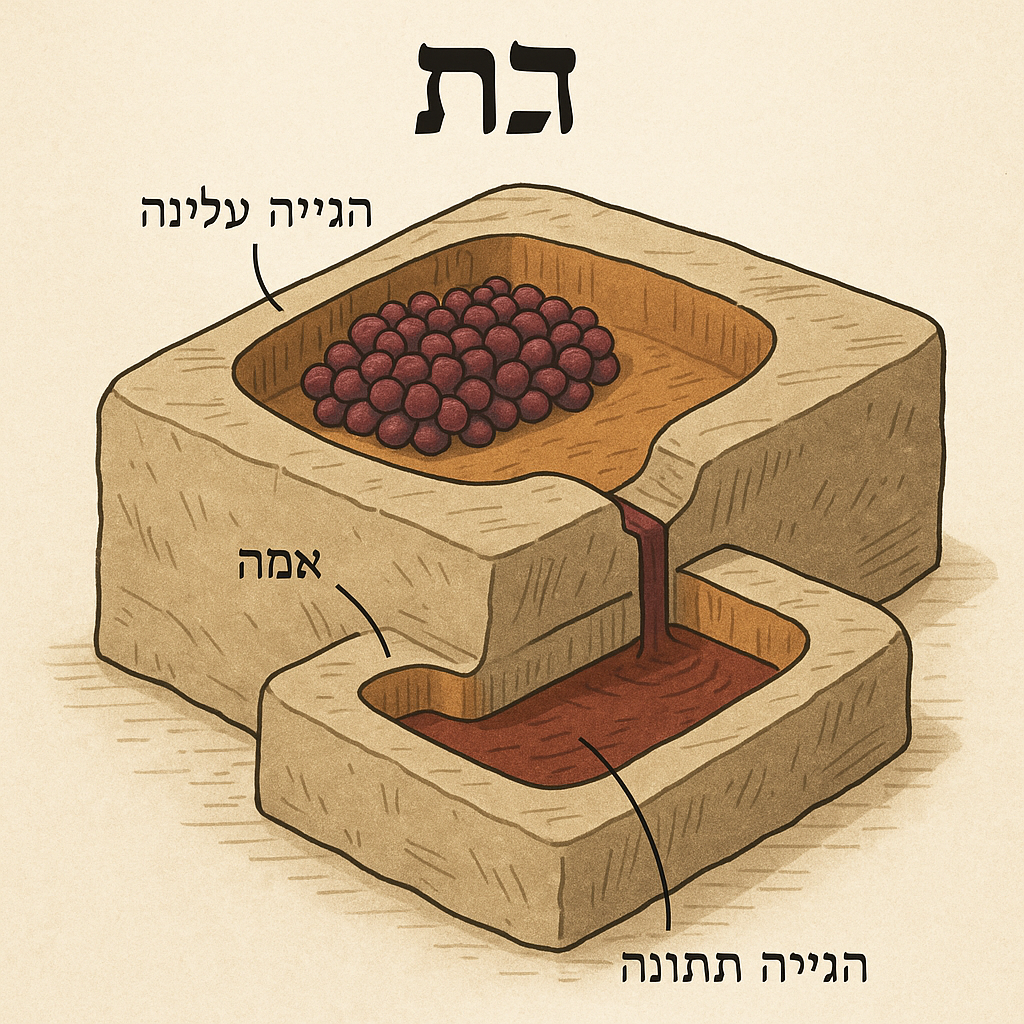
* **Structure**:
* Usually consists of **two parts**:
* **Upper basin**: where grapes were **trodden by foot**.
* **Lower basin**: where the **grape juice (must)** flowed and collected.
* Sometimes included **channels** and **storage pits** carved into stone.
---
### 🔹 **Biblical and Cultural Importance**
* The word *gat* appears frequently in the **Hebrew Bible**:
* Example: *"גַּת בַּיִן"* – *winepress of wine* (Isaiah 63:2–3).
* Symbolically associated with **harvest**, **abundance**, **divine judgment**, or **suffering**.
* Several ancient **place names** are derived from *gat*, including:
* **Gath** (גת פלשתים): one of the five Philistine city-states.
* **Gat-Rimmon** (גת רִמּוֹן): a Levitical town.
---
### 🔹 Modern Use
* **Archaeology**: Ancient gats have been discovered throughout Israel and the Levant, especially in winegrowing regions.
* **Place names**: The term "Gat" appears in modern Israeli localities such as **Kibbutz Gat** or **Givat Gat**.
Gat (גת)
The Hebrew word **גת** (*gat*) refers to an **ancient winepress** and holds both **historical** and **biblical** significance.
---
### 🔹 **Definition of גת (Gat)**
* **Meaning**: A *gat* is a **winepress**, traditionally a **rock-hewn installation** used to **crush grapes** and collect their juice during winemaking.
* **Structure**:
* Usually consists of **two parts**:
* **Upper basin**: where grapes were **trodden by foot**.
* **Lower basin**: where the **grape juice (must)** flowed and collected.
* Sometimes included **channels** and **storage pits** carved into stone.
---
### 🔹 **Biblical and Cultural Importance**
* The word *gat* appears frequently in the **Hebrew Bible**:
* Example: *"גַּת בַּיִן"* – *winepress of wine* (Isaiah 63:2–3).
* Symbolically associated with **harvest**, **abundance**, **divine judgment**, or **suffering**.
* Several ancient **place names** are derived from *gat*, including:
* **Gath** (גת פלשתים): one of the five Philistine city-states.
* **Gat-Rimmon** (גת רִמּוֹן): a Levitical town.
---
### 🔹 Modern Use
* **Archaeology**: Ancient gats have been discovered throughout Israel and the Levant, especially in winegrowing regions.
* **Place names**: The term "Gat" appears in modern Israeli localities such as **Kibbutz Gat** or **Givat Gat**.
