

Vine Life Cycle
## Vine Life Cycle (Vitis vinifera) – Technical Overview
The life cycle of the grapevine (Vitis vinifera) consists of **two parallel frameworks**:
1. **Annual phenological cycle** (repeats every growing season)
2. **Long-term biological life span** (from planting to senescence)
Both are essential for viticulture, vineyard management, and wine quality modeling.
---
# I. Annual Phenological Cycle
In temperate viticultural climates (e.g., Mediterranean conditions typical of Israel), the vine follows a predictable seasonal rhythm regulated primarily by **temperature (Growing Degree Days), photoperiod, and water availability**.
### 1. Winter Dormancy (Endodormancy → Ecodormancy)
**Period:** Late autumn to late winter
**Physiology:**
* Leaf fall triggered by decreasing photoperiod and temperature
* Carbohydrates stored in trunks and roots as starch
* Buds enter dormancy (chilling requirement needed to break)
**Viticultural relevance:**
* Pruning determines yield potential
* Frost protection planning
* Carbohydrate reserve assessment
---
### 2. Budburst (Budbreak)
**Period:** Early spring (≈ 10°C mean daily temperature threshold)
**Process:**
* Sap flow resumes (“bleeding”)
* Bud scales split
* Green shoot emergence
**Risks:**
* Spring frost damage
* Uneven budburst in water-stressed vines
**Technical note:** Timing strongly affects harvest date and style potential.
---
### 3. Shoot Growth & Leaf Development
**Period:** Spring
**Process:**
* Rapid shoot elongation
* Leaf area expansion
* Inflorescence development
**Physiology:**
* Transition from reliance on stored carbohydrates to active photosynthesis
**Management:**
* Canopy positioning
* Shoot thinning
* Early disease control
---
### 4. Flowering (Anthesis)
**Period:** Late spring
**Temperature sensitivity:** Optimal ~20–30°C
**Process:**
* Self-pollination (grapevine is hermaphroditic)
* Fertilization
* Fruit set initiation
**Risks:**
* Coulure (poor fruit set)
* Millerandage (uneven berry size)
Fruit set determines **yield potential**.
---
### 5. Berry Development (Stage I–III Model)
#### Stage I – Rapid Growth (Cell Division)
* Berries small, hard, high organic acids (tartaric & malic)
* Chlorophyll present
#### Stage II – Lag Phase
* Seed maturation
* Slow growth
* Organic acid peak
#### Stage III – Ripening (Veraison onward)
---
### 6. Veraison
**Definition:** Onset of ripening
**Changes:**
* Color change (anthocyanins in red cultivars)
* Sugar accumulation (glucose & fructose)
* Acid degradation (especially malic acid)
* Berry softening
* Aroma precursor synthesis
This stage marks the **metabolic shift from growth to maturation**.
---
### 7. Ripening to Harvest
**Key biochemical processes:**
* Sugar accumulation (Brix increase)
* Acid respiration
* Phenolic polymerization
* Flavor compound development (terpenes, thiols, norisoprenoids)
**Harvest decision based on:**
* Technological maturity (sugar/acid ratio)
* Phenolic maturity
* Aromatic maturity
* Style objectives
---
### 8. Post-Harvest Phase
Even after harvest:
* Photosynthesis continues
* Carbohydrate reserves restored
* Bud differentiation for next season occurs
This stage directly affects **next year's yield and vine balance**.
---
# II. Long-Term Biological Life Cycle
### 1. Establishment Phase (Years 0–3)
* Root system development
* Trunk formation
* First small crop (usually year 2–3)
### 2. Early Production (Years 4–7)
* Increasing yield
* Structural stabilization
### 3. Mature Production (Years 8–25+)
* Yield and quality stabilize
* Root system fully developed
* Balanced vegetative/reproductive growth
### 4. Old Vine Stage (25–40+ years)
* Reduced yield
* Greater root depth
* Often higher fruit concentration
* Increased trunk lignification
### 5. Senescence
* Declining productivity
* Disease accumulation (trunk diseases)
* Eventual vineyard renewal
Some vineyards exceed 80–100 years under proper management.
---
# III. Physiological Control Mechanisms
The vine life cycle is regulated by:
* Temperature (heat summation models)
* Hormones (auxins, gibberellins, ABA during veraison)
* Water status (hydric stress modulates berry size and phenolics)
* Carbohydrate allocation
* Root–shoot signaling
---
# IV. Climatic Influence in Mediterranean Regions (e.g., Israel)
Given your interest in detailed viticultural zoning:
* Mild winters → variable chilling fulfillment
* Hot summers → rapid sugar accumulation
* Diurnal shifts critical for acid retention
* Irrigation management significantly shapes phenology
---
# V. Database Classification Structure (for Wine Atlas Integration)
**Entity:** Vine Life Cycle
**Attributes:**
* Phase name
* Physiological status
* Temperature threshold
* Duration (days/GDD)
* Primary metabolic activity
* Viticultural interventions
* Risk factors
* Impact on wine style
---
If you would like, I can also provide:
* A **GDD-based phenology model table**
* A **BBCH scale mapping for grapevine**
* A **diagrammatic lifecycle chart**
* A **Mediterranean vs Cool Climate comparison model**
* A **database-ready structured schema (SQL/Excel format)**
================================================
## Vine Life Cycle (Vitis vinifera) – Technical Overview
The **vine life cycle** refers to the annual phenological development of the grapevine, primarily of the species *Vitis vinifera*, from winter dormancy through vegetative growth, reproduction (flowering and fruiting), ripening, and return to dormancy. This cycle is climatically regulated (temperature, photoperiod, water availability) and viticulturally managed (pruning, canopy control, irrigation).
The cycle can be divided into two frameworks:
1. **Annual Phenological Cycle (Seasonal)**
2. **Long-Term Biological Life Cycle (From planting to senescence)**
---
# I. Annual Phenological Cycle
### 1. Dormancy (Winter Rest)
**Period:** Late autumn – winter
**Trigger:** Decreasing temperature and daylight
* Leaves senesce and fall.
* Carbohydrates are stored in trunk and roots.
* Buds enter endodormancy (physiological inhibition).
* Cold hardiness develops.
**Viticultural importance:**
Winter pruning determines yield potential and vine balance for the coming season.
---
### 2. Budburst (Budbreak)
**Occurs when:** Soil temperature ≈ 8–10°C; air temperature consistently above 10°C
* Bud scales open.
* Green shoots emerge.
* Sensitive to spring frost.
**Physiological processes:**
Mobilization of stored carbohydrates; root activity resumes.
---
### 3. Shoot Growth & Leaf Development
**Rapid vegetative phase**
* Internode elongation.
* Leaf expansion.
* Inflorescences become visible.
* High nitrogen and water demand.
**Management:**
Shoot thinning, canopy positioning, disease protection.
---
### 4. Flowering (Anthesis)
**Temperature dependent:** Optimal 20–30°C
* Self-pollination occurs (hermaphroditic flowers in *Vitis vinifera*).
* Fruit set follows successful fertilization.
**Critical factor:**
Weather during flowering determines yield potential.
---
### 5. Fruit Set
* Fertilized flowers develop into berries.
* Poor conditions cause **coulure** (flower drop) or **millerandage** (uneven berry size).
---
### 6. Berry Development (Green Growth Phase)
Two sub-phases:
#### Stage I – Cell Division & Expansion
* Rapid berry growth.
* High organic acid accumulation (tartaric, malic).
* Chlorophyll present (berries are green).
#### Stage II – Lag Phase
* Growth slows.
* Seed development completes.
---
### 7. Veraison (Onset of Ripening)
**Key phenological marker**
* Red cultivars develop anthocyanins.
* White cultivars become translucent/yellow.
* Sugar accumulation begins.
* Acidity declines (malic respiration).
This stage signals metabolic transition from growth to ripening.
---
### 8. Ripening (Maturation)
* Sugar accumulation (glucose, fructose).
* Decrease in titratable acidity.
* Phenolic maturation (tannins, anthocyanins).
* Aroma precursor development.
**Harvest timing depends on:**
* °Brix
* pH
* TA
* Phenolic maturity
* Style objective
---
### 9. Post-Harvest Phase
* Photosynthesis continues.
* Carbohydrate reserves replenished.
* Leaf senescence begins.
* Perennial tissues prepare for dormancy.
---
# II. Long-Term Biological Life Cycle
### 1. Propagation
* Sexual (seed) – rare in viticulture.
* Asexual (cuttings, grafting onto rootstocks).
### 2. Establishment (Years 1–3)
* Root system development.
* Trunk formation.
* Limited or no commercial crop.
### 3. Early Production (Years 3–7)
* Increasing yield.
* Structural training completed.
### 4. Mature Phase (Years 8–30+)
* Stable production.
* Balanced vegetative/reproductive growth.
* Often optimal quality period.
### 5. Old Vine Stage (30–100+ years)
* Reduced yield.
* Deep root systems.
* Often associated with concentration and site expression.
### 6. Senescence
* Decline in vigor.
* Increased disease susceptibility.
* Vineyard replanting considered.
---
# Environmental Control Factors
| Factor | Influence |
| ------------------ | ---------------------------------- |
| Temperature | Drives phenological timing |
| Water availability | Controls vigor and berry size |
| Soil type | Root penetration, nutrient supply |
| Sunlight | Photosynthesis, phenolic synthesis |
| Rootstock | Vigor control, drought resistance |
| Pruning | Crop load regulation |
---
# Physiological Summary
The vine is:
* A **perennial woody liana**
* A **C3 photosynthetic plant**
* A **temperate climate species**
* Reproductively active during warm seasons
* Dormant during cold periods
---
If you would like, I can also provide:
* A **BBCH scale table for grapevine**
* A **climate-based phenology comparison (cool vs warm regions)**
* A **database-ready structured schema for phenological tracking**
* A **diagrammatic growth timeline suitable for Wine Atlas**
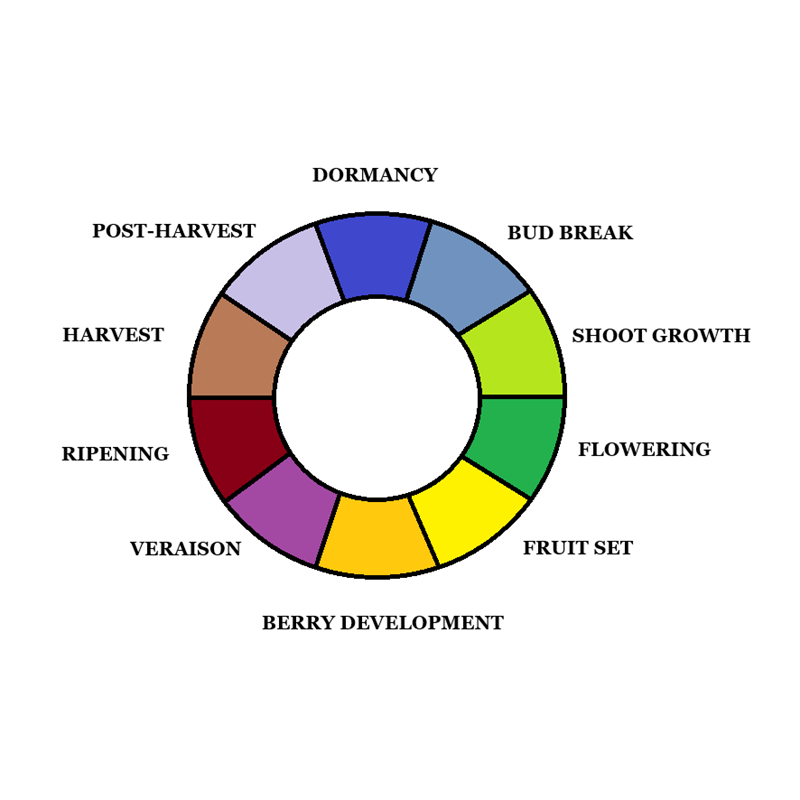
Vine Life Cycle
## Vine Life Cycle (Vitis vinifera) – Technical Overview
The life cycle of the grapevine (Vitis vinifera) consists of **two parallel frameworks**:
1. **Annual phenological cycle** (repeats every growing season)
2. **Long-term biological life span** (from planting to senescence)
Both are essential for viticulture, vineyard management, and wine quality modeling.
---
# I. Annual Phenological Cycle
In temperate viticultural climates (e.g., Mediterranean conditions typical of Israel), the vine follows a predictable seasonal rhythm regulated primarily by **temperature (Growing Degree Days), photoperiod, and water availability**.
### 1. Winter Dormancy (Endodormancy → Ecodormancy)
**Period:** Late autumn to late winter
**Physiology:**
* Leaf fall triggered by decreasing photoperiod and temperature
* Carbohydrates stored in trunks and roots as starch
* Buds enter dormancy (chilling requirement needed to break)
**Viticultural relevance:**
* Pruning determines yield potential
* Frost protection planning
* Carbohydrate reserve assessment
---
### 2. Budburst (Budbreak)
**Period:** Early spring (≈ 10°C mean daily temperature threshold)
**Process:**
* Sap flow resumes (“bleeding”)
* Bud scales split
* Green shoot emergence
**Risks:**
* Spring frost damage
* Uneven budburst in water-stressed vines
**Technical note:** Timing strongly affects harvest date and style potential.
---
### 3. Shoot Growth & Leaf Development
**Period:** Spring
**Process:**
* Rapid shoot elongation
* Leaf area expansion
* Inflorescence development
**Physiology:**
* Transition from reliance on stored carbohydrates to active photosynthesis
**Management:**
* Canopy positioning
* Shoot thinning
* Early disease control
---
### 4. Flowering (Anthesis)
**Period:** Late spring
**Temperature sensitivity:** Optimal ~20–30°C
**Process:**
* Self-pollination (grapevine is hermaphroditic)
* Fertilization
* Fruit set initiation
**Risks:**
* Coulure (poor fruit set)
* Millerandage (uneven berry size)
Fruit set determines **yield potential**.
---
### 5. Berry Development (Stage I–III Model)
#### Stage I – Rapid Growth (Cell Division)
* Berries small, hard, high organic acids (tartaric & malic)
* Chlorophyll present
#### Stage II – Lag Phase
* Seed maturation
* Slow growth
* Organic acid peak
#### Stage III – Ripening (Veraison onward)
---
### 6. Veraison
**Definition:** Onset of ripening
**Changes:**
* Color change (anthocyanins in red cultivars)
* Sugar accumulation (glucose & fructose)
* Acid degradation (especially malic acid)
* Berry softening
* Aroma precursor synthesis
This stage marks the **metabolic shift from growth to maturation**.
---
### 7. Ripening to Harvest
**Key biochemical processes:**
* Sugar accumulation (Brix increase)
* Acid respiration
* Phenolic polymerization
* Flavor compound development (terpenes, thiols, norisoprenoids)
**Harvest decision based on:**
* Technological maturity (sugar/acid ratio)
* Phenolic maturity
* Aromatic maturity
* Style objectives
---
### 8. Post-Harvest Phase
Even after harvest:
* Photosynthesis continues
* Carbohydrate reserves restored
* Bud differentiation for next season occurs
This stage directly affects **next year's yield and vine balance**.
---
# II. Long-Term Biological Life Cycle
### 1. Establishment Phase (Years 0–3)
* Root system development
* Trunk formation
* First small crop (usually year 2–3)
### 2. Early Production (Years 4–7)
* Increasing yield
* Structural stabilization
### 3. Mature Production (Years 8–25+)
* Yield and quality stabilize
* Root system fully developed
* Balanced vegetative/reproductive growth
### 4. Old Vine Stage (25–40+ years)
* Reduced yield
* Greater root depth
* Often higher fruit concentration
* Increased trunk lignification
### 5. Senescence
* Declining productivity
* Disease accumulation (trunk diseases)
* Eventual vineyard renewal
Some vineyards exceed 80–100 years under proper management.
---
# III. Physiological Control Mechanisms
The vine life cycle is regulated by:
* Temperature (heat summation models)
* Hormones (auxins, gibberellins, ABA during veraison)
* Water status (hydric stress modulates berry size and phenolics)
* Carbohydrate allocation
* Root–shoot signaling
---
# IV. Climatic Influence in Mediterranean Regions (e.g., Israel)
Given your interest in detailed viticultural zoning:
* Mild winters → variable chilling fulfillment
* Hot summers → rapid sugar accumulation
* Diurnal shifts critical for acid retention
* Irrigation management significantly shapes phenology
---
# V. Database Classification Structure (for Wine Atlas Integration)
**Entity:** Vine Life Cycle
**Attributes:**
* Phase name
* Physiological status
* Temperature threshold
* Duration (days/GDD)
* Primary metabolic activity
* Viticultural interventions
* Risk factors
* Impact on wine style
---
If you would like, I can also provide:
* A **GDD-based phenology model table**
* A **BBCH scale mapping for grapevine**
* A **diagrammatic lifecycle chart**
* A **Mediterranean vs Cool Climate comparison model**
* A **database-ready structured schema (SQL/Excel format)**
================================================
## Vine Life Cycle (Vitis vinifera) – Technical Overview
The **vine life cycle** refers to the annual phenological development of the grapevine, primarily of the species *Vitis vinifera*, from winter dormancy through vegetative growth, reproduction (flowering and fruiting), ripening, and return to dormancy. This cycle is climatically regulated (temperature, photoperiod, water availability) and viticulturally managed (pruning, canopy control, irrigation).
The cycle can be divided into two frameworks:
1. **Annual Phenological Cycle (Seasonal)**
2. **Long-Term Biological Life Cycle (From planting to senescence)**
---
# I. Annual Phenological Cycle
### 1. Dormancy (Winter Rest)
**Period:** Late autumn – winter
**Trigger:** Decreasing temperature and daylight
* Leaves senesce and fall.
* Carbohydrates are stored in trunk and roots.
* Buds enter endodormancy (physiological inhibition).
* Cold hardiness develops.
**Viticultural importance:**
Winter pruning determines yield potential and vine balance for the coming season.
---
### 2. Budburst (Budbreak)
**Occurs when:** Soil temperature ≈ 8–10°C; air temperature consistently above 10°C
* Bud scales open.
* Green shoots emerge.
* Sensitive to spring frost.
**Physiological processes:**
Mobilization of stored carbohydrates; root activity resumes.
---
### 3. Shoot Growth & Leaf Development
**Rapid vegetative phase**
* Internode elongation.
* Leaf expansion.
* Inflorescences become visible.
* High nitrogen and water demand.
**Management:**
Shoot thinning, canopy positioning, disease protection.
---
### 4. Flowering (Anthesis)
**Temperature dependent:** Optimal 20–30°C
* Self-pollination occurs (hermaphroditic flowers in *Vitis vinifera*).
* Fruit set follows successful fertilization.
**Critical factor:**
Weather during flowering determines yield potential.
---
### 5. Fruit Set
* Fertilized flowers develop into berries.
* Poor conditions cause **coulure** (flower drop) or **millerandage** (uneven berry size).
---
### 6. Berry Development (Green Growth Phase)
Two sub-phases:
#### Stage I – Cell Division & Expansion
* Rapid berry growth.
* High organic acid accumulation (tartaric, malic).
* Chlorophyll present (berries are green).
#### Stage II – Lag Phase
* Growth slows.
* Seed development completes.
---
### 7. Veraison (Onset of Ripening)
**Key phenological marker**
* Red cultivars develop anthocyanins.
* White cultivars become translucent/yellow.
* Sugar accumulation begins.
* Acidity declines (malic respiration).
This stage signals metabolic transition from growth to ripening.
---
### 8. Ripening (Maturation)
* Sugar accumulation (glucose, fructose).
* Decrease in titratable acidity.
* Phenolic maturation (tannins, anthocyanins).
* Aroma precursor development.
**Harvest timing depends on:**
* °Brix
* pH
* TA
* Phenolic maturity
* Style objective
---
### 9. Post-Harvest Phase
* Photosynthesis continues.
* Carbohydrate reserves replenished.
* Leaf senescence begins.
* Perennial tissues prepare for dormancy.
---
# II. Long-Term Biological Life Cycle
### 1. Propagation
* Sexual (seed) – rare in viticulture.
* Asexual (cuttings, grafting onto rootstocks).
### 2. Establishment (Years 1–3)
* Root system development.
* Trunk formation.
* Limited or no commercial crop.
### 3. Early Production (Years 3–7)
* Increasing yield.
* Structural training completed.
### 4. Mature Phase (Years 8–30+)
* Stable production.
* Balanced vegetative/reproductive growth.
* Often optimal quality period.
### 5. Old Vine Stage (30–100+ years)
* Reduced yield.
* Deep root systems.
* Often associated with concentration and site expression.
### 6. Senescence
* Decline in vigor.
* Increased disease susceptibility.
* Vineyard replanting considered.
---
# Environmental Control Factors
| Factor | Influence |
| ------------------ | ---------------------------------- |
| Temperature | Drives phenological timing |
| Water availability | Controls vigor and berry size |
| Soil type | Root penetration, nutrient supply |
| Sunlight | Photosynthesis, phenolic synthesis |
| Rootstock | Vigor control, drought resistance |
| Pruning | Crop load regulation |
---
# Physiological Summary
The vine is:
* A **perennial woody liana**
* A **C3 photosynthetic plant**
* A **temperate climate species**
* Reproductively active during warm seasons
* Dormant during cold periods
---
If you would like, I can also provide:
* A **BBCH scale table for grapevine**
* A **climate-based phenology comparison (cool vs warm regions)**
* A **database-ready structured schema for phenological tracking**
* A **diagrammatic growth timeline suitable for Wine Atlas**
