
Biodynamic Winemaking
Biodynamic winemaking is a holistic approach to viticulture and winemaking that treats the vineyard as a self-sustaining ecosystem. It extends beyond organic practices by following the biodynamic agricultural principles established by Rudolf Steiner in the early 20th century. These principles emphasize the integration of cosmic and terrestrial forces, aiming to enhance the health and vitality of the soil, plants, and animals within the farm system.
Preparations
Biodynamic farming uses specific preparations made from fermented manure, minerals, and herbs (numbered 500-508) to enhance soil quality and stimulate plant life. These are applied to the vineyard in small doses, much like homeopathic remedies for the earth.
Cosmic Rhythms
Planting, pruning, and harvesting activities are timed to coincide with lunar and astrological cycles, based on the belief that cosmic forces affect plant growth and development.
Closed System
The aim is to create a self-sustaining vineyard that generates its own fertility and pest control through the integration of crops, livestock, and composting, minimizing the need for external inputs.
Soil Health
A major focus is on fostering soil health through composting, cover cropping, and deep respect for the earth, which is considered the foundation of a healthy ecosystem capable of producing high-quality grapes.
Biodiversity
Biodynamic vineyards often emphasize biodiversity, incorporating a variety of plants and animals to create a balanced ecosystem that supports the health of the vines and mitigates pest and disease pressure.
Minimal Intervention in Winemaking
Similar to natural winemaking, biodynamic winemaking practices often involve minimal intervention. This can include the use of native yeasts for fermentation and avoiding or minimizing the use of additives and sulfites, aiming to produce wine that is a true expression of its terroir.
Certification and Labeling
Biodynamic certification requires adherence to these practices and is overseen by organizations such as Demeter, the primary certification body for biodynamic agriculture. Certification ensures that both the grape-growing and winemaking processes meet strict biodynamic standards, providing a guarantee of practice and quality to consumers.
Biodynamic winemaking is considered by its practitioners and advocates to not only produce wines of distinctive character and quality but also to enhance the sustainability and vitality of the land. It's part of a broader movement toward more ecological and sustainable farming practices, with a deep emphasis on understanding and working within the natural rhythms of the earth.
-------------------------------------------
Biodynamic winemaking is an agricultural and winemaking approach that follows the principles of biodynamics, a holistic and spiritual farming philosophy developed by Austrian philosopher Rudolf Steiner in the early 20th century. Biodynamic winemaking treats the vineyard as a self-sustaining ecosystem, integrating organic farming practices with specific rituals and preparations aimed at enhancing the health and vitality of the soil, plants, and environment. Here are the key principles and practices of biodynamic winemaking:
Holistic Approach
- Biodynamic winemaking views the vineyard as a single, interconnected organism, with the goal of achieving balance and harmony within the ecosystem.
Soil Health
- Emphasis is placed on building and maintaining soil fertility through composting, cover cropping, and crop rotation, with the aim of creating living soil teeming with microbial life.
Biodynamic Preparations
- Biodynamic practitioners use special preparations made from fermented herbs, minerals, and animal substances, which are applied to the soil, compost, and plants at specific times in the biodynamic calendar. These preparations are believed to enhance soil fertility, promote plant health, and improve the vitality of the vineyard.
Lunar and Cosmic Rhythms
- Biodynamic winemaking follows a planting and harvesting calendar based on lunar and cosmic rhythms, which are believed to influence the growth and development of plants. Planting, pruning, and other vineyard activities are timed to coincide with favorable cosmic conditions.
Biodiversity
- Biodynamic vineyards promote biodiversity by encouraging the presence of diverse plant and animal species, which help to maintain ecological balance and reduce the need for external inputs.
Minimal Intervention
- While biodynamic winemaking shares many practices with organic farming, it often goes further in its emphasis on natural processes and minimal intervention in the vineyard and winery. This includes avoiding the use of synthetic pesticides, herbicides, and fertilizers, as well as minimizing additives and manipulations in the cellar.
Certification
- Biodynamic wineries may seek certification from organizations such as Demeter International, which sets standards for biodynamic agriculture and certification worldwide. Demeter certification requires adherence to strict guidelines and regular inspections to ensure compliance.
Overall, biodynamic winemaking seeks to produce wines that are not only of high quality but also express the unique terroir of the vineyard and reflect the interconnectedness of the natural world. While the practices of biodynamic winemaking may seem esoteric to some, many producers and consumers believe that they result in wines with greater depth, complexity, and vitality.
===========================================
**Biodynamic winemaking** is a holistic and regenerative approach to viticulture and winemaking that follows the principles established by Austrian philosopher **Rudolf Steiner** in the 1920s. It treats the vineyard as a self-sustaining ecosystem, integrating organic farming practices with cosmic and lunar cycles to enhance soil health, vine vitality, and overall wine quality.
#### **Key Principles**
1. **Holistic Vineyard Management**
- The vineyard is seen as a **living organism**, fostering biodiversity and self-sufficiency.
- No synthetic fertilizers, herbicides, or pesticides; only natural composts, cover crops, and livestock integration.
- Emphasis on soil regeneration, microbial life, and closed-loop farming.
2. **Biodynamic Preparations**
- Special herbal, mineral, and manure-based treatments (Preparations 500–508) are used to enrich the soil and vines.
- Examples:
- **Preparation 500**: Cow horn filled with fermented manure, buried in the soil to enhance root strength.
- **Preparation 501**: Ground quartz (silica) to boost photosynthesis and grape ripening.
- **Herbal Sprays**: Chamomile, nettle, yarrow, valerian, and dandelion teas to balance soil nutrients.
3. **Lunar and Cosmic Rhythms**
- Vineyard activities (planting, pruning, harvesting) follow the **biodynamic calendar**, aligning with moon phases and planetary cycles.
- The calendar divides days into **Root, Fruit, Flower, and Leaf Days**, guiding optimal winemaking tasks.
4. **Minimal Intervention Winemaking**
- Spontaneous fermentation using native yeasts.
- Little to no fining, filtration, or added sulfur dioxide (SO₂).
- Focus on preserving the natural expression of terroir.
#### **Certifications**
- **Demeter International** (global biodynamic certification).
- **Biodyvin** (European biodynamic wine certification).
#### **Biodynamic vs. Organic & Sustainable Winemaking**
- **Organic**: Avoids synthetic chemicals but does not require lunar cycles or biodynamic preparations.
- **Sustainable**: Balances environmental, economic, and social factors but allows some synthetic inputs.
- **Biodynamic**: Goes beyond organic with spiritual and cosmic elements, treating the vineyard as a self-regenerating entity.
#### **Challenges & Controversies**
- Scientific skepticism regarding the effectiveness of lunar cycles and preparations.
- Labor-intensive and higher production costs.
- Risk of inconsistency due to minimal intervention practices.
Despite debates, **biodynamic winemaking has gained prestige**, with top producers in France (Burgundy, Loire, Rhône), Italy, Germany, and the U.S. adopting its methods to craft expressive and terroir-driven wines.

Modern Winemaking
Modern Winemaking refers to the use of scientific advancements, technological innovations, and controlled processes to produce consistent, high-quality wines. This approach integrates data-driven viticulture, precision fermentation, and advanced aging techniques to enhance efficiency, maintain stability, and refine the sensory characteristics of wine. Modern winemaking is widely practiced in both large-scale commercial wineries and boutique operations aiming for precision and quality control.
1. **Precision Viticulture**
- Uses satellite imagery, drones, and soil sensors to monitor vineyard conditions.
- Optimizes irrigation, nutrient management, and canopy control to maximize grape quality.
2. **Mechanized Harvesting & Sorting**
- Grapes are often harvested using machines for efficiency, though some premium wineries still hand-pick.
- Optical sorting technology removes damaged or underripe grapes.
3. **Controlled Fermentation**
- Stainless steel tanks with temperature control ensure consistency and preserve fresh fruit flavors.
- Selected commercial yeast strains optimize fermentation speed and enhance specific aromas.
- Oxygen management (e.g., micro-oxygenation) helps refine tannins and texture.
4. **Use of Additives & Processing Aids**
- Sulfur dioxide (SO₂) is used to prevent oxidation and microbial spoilage.
- Enzymes, tannin powders, and acid adjustments may be applied for balance.
- Fining agents (e.g., bentonite, activated charcoal) clarify wine and remove unwanted compounds.
5. **Standardization & Stability**
- Reverse osmosis, spinning cone technology, and other filtration methods control alcohol levels and remove defects.
- Cold stabilization prevents tartrate crystallization in white wines.
6. **Controlled Aging & Oak Influence**
- Wines may be aged in oak barrels, oak staves, or oak chips to achieve desired complexity.
- Modern wineries experiment with different toast levels and barrel types for specific flavor profiles.
7. **Bottling & Preservation Innovations**
- Sterile filtration ensures microbial stability before bottling.
- Alternative closures (e.g., screw caps, synthetic corks) extend shelf life and reduce cork taint risks.
#### **Characteristics of Modern Wines:**
- **Consistency:** Achieves reliable flavor and aroma profiles across vintages.
- **Fruit-Forward Expression:** Emphasizes ripe fruit characteristics and clean flavors.
- **Approachability:** Often designed for early drinking rather than long-term aging.
- **Polished & Smooth:** Refined tannins and balanced acidity make wines more accessible to consumers.
#### **Historical Context & Evolution:**
- The modern era of winemaking began in the mid-20th century, driven by scientific research and technological breakthroughs.
- The **University of California, Davis (USA)** and **INRA (France)** contributed to the understanding of fermentation, vine health, and sensory evaluation.
- Regions such as **California, Australia, Chile, and South Africa** pioneered modern techniques, leading to the rise of "New World" wine styles.
#### **Criticism & Challenges:**
- Some traditionalists argue that modern winemaking prioritizes homogeneity over terroir expression.
- The use of additives and manipulation may diminish the natural character of the wine.
- Mass production can overshadow artisanal winemaking and local traditions.
Despite these concerns, modern winemaking continues to push boundaries, blending science with artistry to produce wines that appeal to diverse global markets.
Organic Winemaking
Organic Winemaking refers to the process of producing wine using grapes that have been grown according to organic farming principles, without the use of synthetic pesticides, herbicides, fungicides, or fertilizers. The focus is on maintaining a healthy vineyard ecosystem and promoting biodiversity. Beyond the vineyard, organic winemaking practices extend to the cellar, where the winemaking process is regulated to ensure that the final product meets organic certification standards. Organic winemaking is part of a broader movement towards sustainability and environmental responsibility in the wine industry, emphasizing the health of the ecosystem, the workers, and the consumers.
1. **Organic Certification**: To be labeled as organic, both the vineyard where the grapes are grown and the winery where the wine is made must be certified by an accredited organic certification body. This process involves adhering to strict guidelines and undergoing regular inspections.
2. **No Synthetic Chemicals**: Organic viticulture prohibits the use of synthetic pesticides, herbicides, fungicides, and fertilizers. Instead, organic growers use natural methods and substances to manage pests and diseases and to nourish the soil.
3. **Soil Health**: A significant focus is placed on maintaining and enhancing soil health through organic matter addition (compost, green manure), cover cropping, and crop rotation, among other practices.
### In the Winery
1. **Additives and Processing Aids**: The use of additives and processing aids is heavily regulated in organic winemaking. While some additives, like sulfur dioxide (SO2), are permitted, they are often restricted to lower levels than those allowed in conventional winemaking. The aim is to minimize intervention and ensure that the wine reflects the natural characteristics of the grapes.
2. **Fermentation**: Organic winemaking encourages the use of natural or indigenous yeasts for fermentation, although this is not a strict requirement. Some organic wines are made using selected yeasts that are certified organic.
3. **Certification and Labeling**: For a wine to be labeled as "organic" and carry the organic certification seal, it must meet the organic standards set by the certifying body, which can vary by country. For example, in the United States, the USDA (United States Department of Agriculture) through its National Organic Program (NOP) sets the standards for organic certification. In the European Union, organic wines must meet EU organic regulations.
### Considerations
- **Sulfites**: A notable difference in regulations exists concerning sulfites. In the U.S., wines labeled as "organic" must contain no added sulfites, but wines can be labeled as "made with organic grapes" if they contain added sulfites within a certain limit. In contrast, the EU allows the addition of limited sulfites in organic wine.
- **Labeling**: The specific labeling (e.g., "organic wine" vs. "made with organic grapes") can provide clues about the practices used in the vineyard and winery, reflecting the regulatory differences between regions.
Sustainable Winemaking
Sustainable Winemaking refers to the practice of producing wine in an environmentally responsible, economically viable, and socially equitable manner. It encompasses vineyard management, winemaking processes, and business operations with a focus on reducing environmental impact, conserving resources, and ensuring long-term viability for future generations. Sustainable winemaking represents a growing movement in the wine industry, aiming to create high-quality wines while protecting natural resources and fostering ethical business practices.
1. **Environmental Responsibility**
- **Soil Health**: Use of cover crops, composting, and minimal tillage to preserve soil fertility.
- **Water Conservation**: Efficient irrigation techniques, rainwater harvesting, and wastewater treatment.
- **Biodiversity**: Maintaining natural habitats, reducing monoculture risks, and integrating beneficial plants and animals.
- **Energy Efficiency**: Adoption of renewable energy (solar, wind), reduced carbon footprint, and eco-friendly packaging.
Environmental Stewardship
- **Biodiversity**: Maintaining or increasing the diversity of plant and animal life in and around vineyards to support a healthy ecosystem.
- **Soil Management**: Using practices that prevent erosion, improve soil structure, and enhance fertility naturally, such as cover cropping and minimal tillage.
- **Water Management**: Efficiently using water resources and improving water quality through conservation practices and infrastructure.
- **Energy Efficiency**: Reducing the carbon footprint by optimizing energy use and investing in renewable energy sources, like solar or wind power.
- **Pest Management**: Employing integrated pest management (IPM) strategies that use a combination of biological, cultural, physical, and, as a last resort, chemical methods to manage pests and diseases.
- **Waste Management**: Minimizing waste through recycling, composting, and repurposing byproducts of the winemaking process.
2. **Winemaking Practices**
- Minimal chemical inputs such as synthetic fertilizers, herbicides, and pesticides.
- Reduction of waste through composting, recycling, and sustainable bottling practices (lightweight glass, alternative closures).
- Use of energy-efficient technologies in wineries, such as gravity-fed systems and solar-powered facilities.
3. **Social and Economic Sustainability**
- Fair labor practices, equitable wages, and safe working conditions for vineyard and winery workers.
- Community engagement and support for local economies.
- Long-term business strategies that ensure financial stability while maintaining ecological balance.
### Economic Viability
- **Long-Term Planning**: Implementing practices that ensure the economic health and viability of the wine business over the long term, including adapting to climate change.
- **Market Responsiveness**: Producing wines that meet consumer demand for sustainability, including transparency about winemaking practices.
### Social Equity
- **Worker Welfare**: Ensuring fair labor practices, safe working conditions, and opportunities for education and advancement for all employees.
- **Community Engagement**: Contributing to the local community through education, philanthropy, and participation in local events and initiatives.
#### **Certifications and Standards**
While "sustainable" does not have a universal definition, various certification programs set guidelines for sustainable viticulture and winemaking, including:
- **Certified Sustainable Winegrowing (California)**
- **SIP Certified (Sustainability in Practice)**
- **B Corp Certification**
- **LIVE Certified (Low Input Viticulture and Enology, Pacific Northwest)**
- **The Porto Protocol** (global sustainability initiative)
### Certification and Labeling
Various organizations around the world offer sustainability certifications for vineyards and wineries that meet their specific criteria. These certifications often require participants to undergo regular evaluations and demonstrate continuous improvement in their practices. However, since "sustainable" can be a broad and somewhat subjective term, standards can vary significantly between certifications. Consumers looking to support sustainable winemaking practices may look for specific certification labels or seek out information on a winery's practices.
#### **Sustainability vs. Organic & Biodynamic**
Unlike organic or biodynamic certifications, which have specific, codified standards, sustainability in winemaking often follows broader principles and can be adapted to fit the unique challenges and opportunities of a particular vineyard or region.
- **Organic Winemaking**: Prohibits synthetic chemicals but does not necessarily include energy conservation or fair labor practices.
- **Biodynamic Winemaking**: A holistic approach incorporating organic practices with lunar cycles and specific preparations but may not address broader sustainability issues like carbon footprint.
- **Sustainable Winemaking**: Balances environmental, economic, and social considerations without strictly adhering to organic or biodynamic methods.
#### **Challenges & Future Directions**
- Balancing sustainability with profitability.
- Addressing climate change impacts (e.g., rising temperatures, extreme weather).
- Consumer awareness and demand for sustainable wines.
Natural Winemaking
Natural Winemaking is a minimalist approach to wine production that emphasizes minimal human intervention and the use of organically or biodynamically farmed grapes. It follows the philosophy of "nothing added, nothing removed," meaning that the winemaking process avoids additives, chemical inputs, and technological manipulations.
#### **Key Principles of Natural Winemaking:**
1. **Organic or Biodynamic Viticulture**
- Grapes are cultivated without synthetic pesticides, herbicides, fungicides, or chemical fertilizers.
- Some natural winemakers follow biodynamic principles, incorporating lunar cycles and holistic farming methods.
2. **Hand-Harvesting**
- Grapes are typically hand-picked to ensure optimal ripeness and quality.
- Machine harvesting is avoided to prevent premature oxidation and unnecessary stress on the grapes.
3. **Spontaneous Fermentation**
- Natural yeasts present on grape skins and in the winery environment initiate fermentation.
- No commercial yeasts or fermentation enhancers are used.
4. **Minimal or No Sulfites (SO₂)**
- Sulfur dioxide (SO₂) is commonly used in conventional winemaking to prevent oxidation and microbial spoilage.
- In natural winemaking, SO₂ is either eliminated or used in very low amounts, usually at bottling.
5. **No Additives or Processing Aids**
- Common winemaking additives (e.g., sugar, acid, enzymes, tannins) are avoided.
- Fining and filtration are minimal or nonexistent, preserving the wine’s natural structure.
6. **No Heavy Filtration or Clarification**
- Wines are often unfiltered and unfined, leading to a cloudy appearance and potential sediment.
- This allows for more complex flavors and textures.
7. **Expression of Terroir**
- Natural wines aim to reflect the unique characteristics of the vineyard (terroir) without manipulation.
- Each vintage and bottle may vary due to the absence of standardization techniques.
#### **Characteristics of Natural Wine:**
- **Appearance:** Often unfiltered and cloudy.
- **Aroma & Taste:** Can be more vibrant, funky, or unpredictable due to natural fermentation.
- **Texture:** May be more rustic, with slight effervescence in some cases due to active microorganisms.
#### **History & Modern Movement:**
- The philosophy of natural winemaking dates back to ancient wine production, where winemakers had no access to modern additives or technology.
- The modern natural wine movement gained momentum in the late 20th century, particularly in France, Italy, and Spain, with winemakers such as Jules Chauvet and Marcel Lapierre pioneering the approach.
- Today, natural wine is a global trend, with dedicated wine bars, festivals, and consumer demand increasing worldwide.
#### **Criticism & Challenges:**
- **Stability & Consistency:** Without sulfites and additives, natural wines can be more prone to oxidation and spoilage.
- **Lack of Regulation:** There is no official certification for "natural wine," leading to debates over what qualifies as truly natural.
- **Acquired Taste:** The unconventional flavors and textures may not appeal to all consumers.
Despite these challenges, natural winemaking continues to grow as a movement that champions authenticity, environmental sustainability, and artisanal craftsmanship in wine production.
Amphorae
Amphorae (singular: Amphora) are ancient ceramic vessels with two handles and a narrow neck, commonly used by the Greeks, Romans, and other Mediterranean civilizations for storing and transporting liquids like wine, olive oil, and grains. They were typically made of clay and varied in shape depending on their regional origin and specific use. Many amphorae were also stamped or inscribed to indicate their origin, contents, or manufacturer.
Chaptalization
Chaptalization is a winemaking process in which sugar is added to grape must (crushed grape juice with skins, seeds, and stems) before or during fermentation. The purpose is to increase the alcohol content of the final wine by providing more fermentable sugars for the yeast to convert into alcohol.
### Key Points About Chaptalization:
1. **Purpose:**
- Chaptalization is used when grapes lack sufficient natural sugar due to factors like cooler climates, poor weather conditions, or early harvests.
- It does not aim to sweeten the wine but to balance alcohol levels in under-ripened grapes.
2. **Process:**
- The sugar added is usually sucrose (table sugar) or sometimes concentrated grape must.
- The amount added is carefully calculated to avoid over-alcoholic wines.
3. **Legal Restrictions:**
- Chaptalization is regulated or prohibited in some winemaking regions to preserve traditional winemaking practices and ensure quality.
- For instance:
- Allowed in cooler regions like Burgundy or Bordeaux under specific conditions.
- Prohibited in many warmer regions, such as Italy, Spain, and California, where grapes naturally ripen well.
4. **Impact on Wine:**
- It allows winemakers to achieve balance and structure in wines that might otherwise be thin or low in alcohol.
- Excessive chaptalization can lead to unbalanced wines with overly high alcohol content.
Chaptalization is named after **Jean-Antoine Chaptal**, a French chemist who promoted its use in the early 19th century.
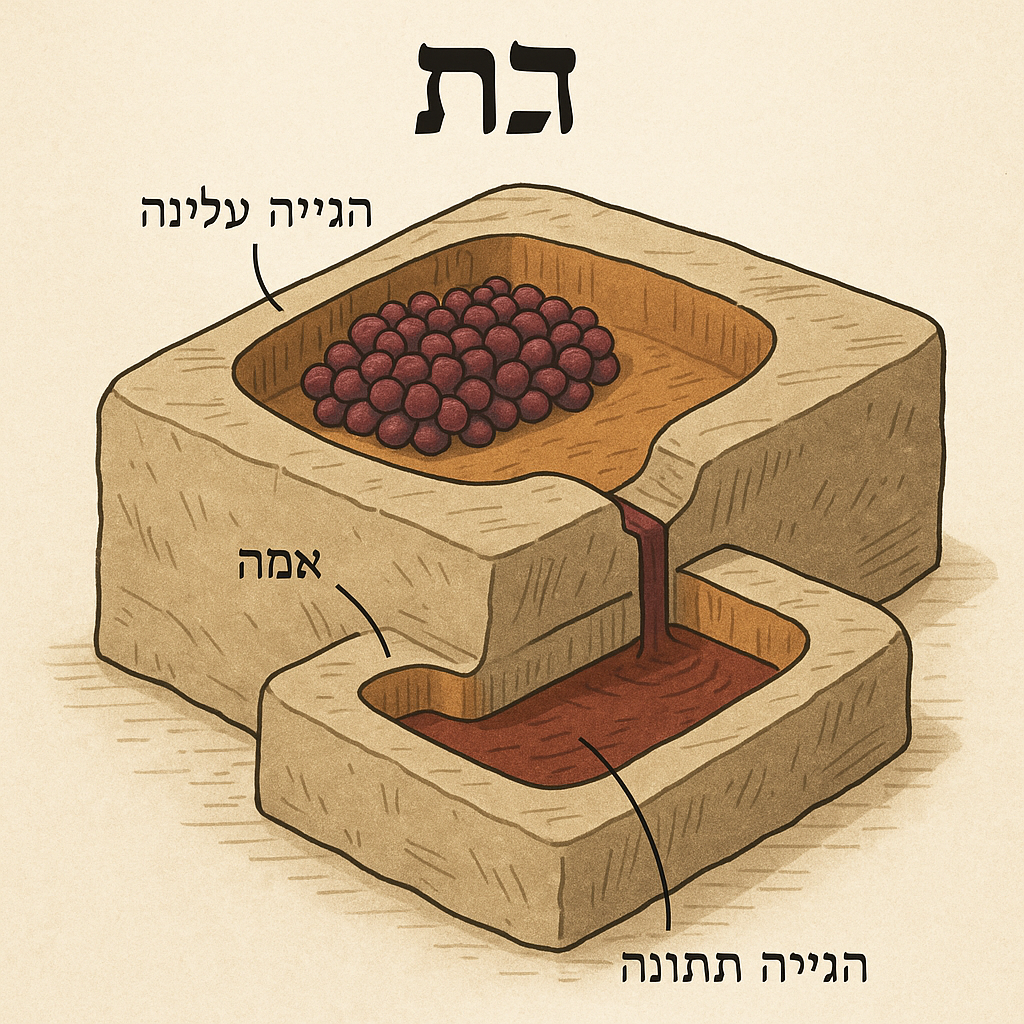
Gat (גת)
The Hebrew word **גת** (*gat*) refers to an **ancient winepress** and holds both **historical** and **biblical** significance.
---
### 🔹 **Definition of גת (Gat)**
* **Meaning**: A *gat* is a **winepress**, traditionally a **rock-hewn installation** used to **crush grapes** and collect their juice during winemaking.
* **Structure**:
* Usually consists of **two parts**:
* **Upper basin**: where grapes were **trodden by foot**.
* **Lower basin**: where the **grape juice (must)** flowed and collected.
* Sometimes included **channels** and **storage pits** carved into stone.
---
### 🔹 **Biblical and Cultural Importance**
* The word *gat* appears frequently in the **Hebrew Bible**:
* Example: *"גַּת בַּיִן"* – *winepress of wine* (Isaiah 63:2–3).
* Symbolically associated with **harvest**, **abundance**, **divine judgment**, or **suffering**.
* Several ancient **place names** are derived from *gat*, including:
* **Gath** (גת פלשתים): one of the five Philistine city-states.
* **Gat-Rimmon** (גת רִמּוֹן): a Levitical town.
---
### 🔹 Modern Use
* **Archaeology**: Ancient gats have been discovered throughout Israel and the Levant, especially in winegrowing regions.
* **Place names**: The term "Gat" appears in modern Israeli localities such as **Kibbutz Gat** or **Givat Gat**.
Karas
Karas (Armenian: կարաս) is a traditional Armenian clay vessel used for fermenting, aging, and storing wine. Similar to the Georgian Qvevri and ancient amphorae, Karases have been used in Armenia for winemaking for thousands of years. They are typically buried underground to provide natural temperature control during fermentation, contributing to the unique characteristics of Armenian wines.
Minerality
Glossary

- Filter by CategoryFilter with Group