

0
0
0
Maghraani Kiss
Registration No. 981
Registration date : 31/05/2021
Place of Origin : Maghraanis Kisi
Name of the goods for which registration of the appellation of origin is requested : Wine
Name and address of the applicant : A ( A ) IP – “ Maghraani Wine ”, village Maghraani, Akhmeta district, Georgia (GE)
1. Place of Origin : Maghraani Kisi
2. Product Description
2.1. Product Category
Wine "Magraanis Kisi" can only be:
· White dry;
· Amber dry.
2.2 . Organoleptic characteristics of the product
Wine "Magraanis Kisi" white dry must meet the following requirements:
· Color - from light straw to light golden;
· Aroma and taste - flawless, delicate on the palate, soft, cheerful, harmonious, refined, with a varietal aroma characteristic of this geographical area, with tones of wildflowers, fruits (mostly apple, pear and peach) and citrus;
· During aging, the wine develops aromas of dried herbs and dried fruits.
Wine "Magraanis Kisi" amber dry must meet the following requirements:
· Color - from golden to dark amber;
· Aroma and taste - flawless, soft, refined, harmonious, full-bodied, velvety, with a well-expressed varietal aroma, moderate and mild bitterness. Fruit aromas dominate in young wine, mostly apple, pear and peach;
· As it ages, the wine develops a bouquet with notes of roasted almonds and dried apricots .
2. 3. Physical and chemical characteristics of the product
Wine "Magraanis Kisi " white dry must meet the following requirements:
· Actual alcohol content by volume - not less than 11%;
· Total alcohol content by volume - no more than 15%;
· Sugar content - no more than 4 g/l;
· Titrate acidity, calculated as wine acidity, must be: in young wine, not less than 5 g/l, and in mature wine - not less than 4.3 g/l;
· Volatile acidity calculated as acetic acid - no more than 1.0 g/l;
· Total mass concentration of sulfur dioxide - no more than 200 mg/l;
· The mass concentration of the sugar-free extract should not be less than 16 g/l.
Wine "Magraanis Kisi" amber dry must meet the following requirements:
· Actual alcohol content by volume - not less than 12%;
· Total alcohol content by volume - no more than 15%;
· Sugar content - no more than 4 g/l;
· Titrate acidity, calculated as tartaric acid, must not be less than 3.5 g/l;
· Volatile acidity, calculated as acetic acid - no more than 1.2 g/l;
· Total mass concentration of sulfur dioxide - no more than 150 mg/l;
· The mass concentration of the sugar-free extract should not be less than 22 g/l.
3. Boundaries of the geographical area of production – microzone
The Maghraani microzone is located in Inner Kakheti , within the administrative borders . From the north it is bordered by the southern and western slopes of the Caucasus Range, from the west by the watershed ridge of S. Pichkhovani and S. Zemo Alvani, from the east by the Babaneuri State Reserve, and from the south by the Babaneuri River .
The Maghraani microzone includes the villages of Maghraani, Pichkhovani, Argokhi and Babaneuri.
Grapes intended for the production of the wine “Magraani Kis” must be harvested only from vineyards cultivated in the Magraani microzone.
Grape processing and winemaking take place within the territory of the Maghraani microzone. Grape processing and winemaking are also permitted outside the Maghraani microzone, only within the Kakheti viticulture zone.
4. Grape varieties
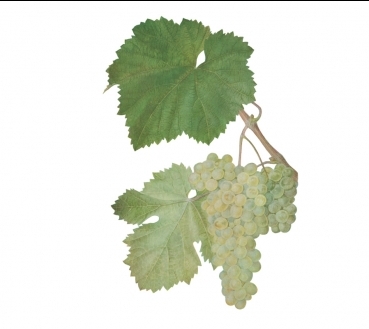
"Magraani Kis" can only be made from Kis grapes (synonym - "Magraani Kis").
The use of other varieties is not permitted.
5. Vineyard cultivation , pruning - formation and maintenance
· In the Maghraani microzone , the entrepreneurial vines intended for the production of the wine “Maghraani Kis ” must be cultivated at an altitude of 400–800 meters above sea level;
· The distance between rows in the vineyard should be from 1.0 to 2.5 meters;
· The distance between vines in a row is 0.8 - 1.5 meters;
· Stem height – 70–90 cm;
· Shape of the crown – single or double Georgian, single or double cordon, free .
6. Grape maturity , harvest , transportation
The wine "Magraanis Kisi" is made from ripe grapes whose sugar content meets the following requirements:
· "Magraanis Kisi" white dry – not less than 19%;
· "Magraani Kisi" amber dry – not less than 20%.
To make the wine "Magraanis Kisi" amber, the grape must be ripe.
Grapes may only be transported in wooden or plastic boxes, as well as in stainless steel containers. The use of polyethylene bags and/or sacks is prohibited when transporting grapes.
7. Grape harvest and wine production
The grape harvest per 1 hectare of vineyard should not exceed 8 tons .
The wine yield should not exceed 650 liters from one ton of grapes .
8. Grape processing , winemaking and bottling
· Wine " Magraanis Kisi " white dry
The white wine “Magraanis Kisi” is made only from self-fermenting sweet grapes. After pressing the grapes and pressing the self-fermenting sweet grapes, they are boiled at a temperature not exceeding 20 ° C.
Maceration of the wort before fermentation and/or at the beginning of fermentation is permitted.
Wine can be aged or bottled without aging. In the case of aging, it is mandatory to age the wine in oak barrels for at least 6 months.
· " Magraanis Kiss " amber dry
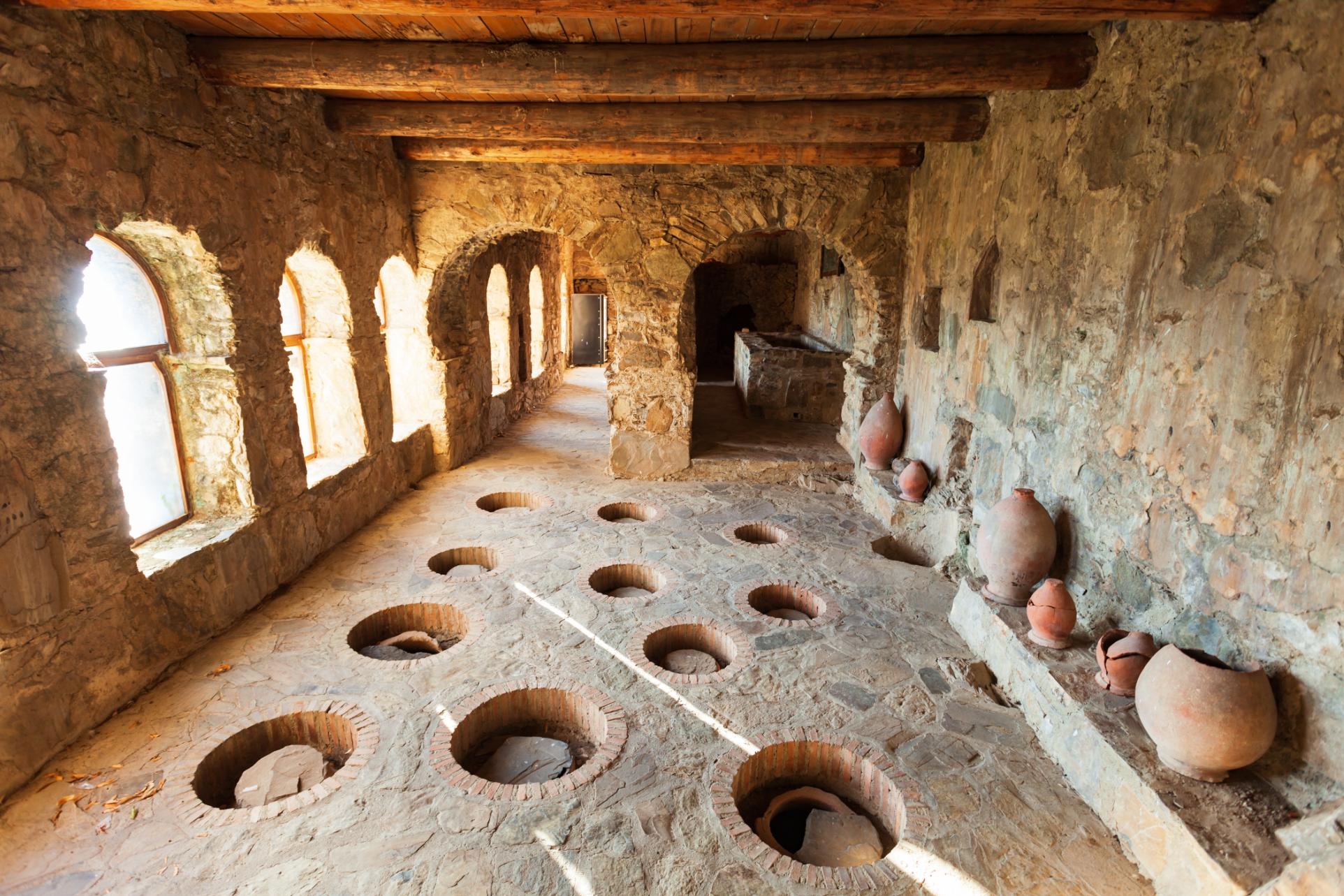
When making “Magraanis Kisi” amber wine, alcoholic fermentation takes place only in qvevris on full durdo. Fermentation takes place at a temperature of no more than 28 ° C under conditions of intensive stirring (4-5 times a day). After the completion of alcoholic fermentation, the qvevris are filled with similar wine and left on durdo for no less than February 1 of the year following the vintage. After that, the wine is removed from the lees and lees and transferred to another vessel.
Wine can be aged or bottled without aging. In the case of aging, it is mandatory to age the wine in oak barrels for at least 6 months.
Wine "Magraani Kisi" may only be placed on the consumer market in bottles with a volume of no more than 5 liters.
9. The connection between the exceptional quality of wine , its reputation and its geographical location
9.1 . Natural factors :
Climate
The microclimate in the Maghraani microzone is determined by the characteristics of the local terrain.
The vineyards of the Maghrani microzone are cultivated on the southern and southwestern slopes of the Caucasus in the valleys of the Machareuli, Babaneulistskali and Maghranistkali rivers.
The climate in the microzone is temperate continental, with relatively humid , hot summers and long , cold winters .
The microzone is distinguished by a high level of solar radiation, as the slopes in the microzone face south. The annual duration of sunlight is quite high and exceeds 2,050 hours. The average annual temperature is 12.2-12.4 °C . The hottest month of the year is July. In some years, the temperature reaches +40 °C . The coldest month is January. In some years, the temperature drops to -16 °C .
The annual amount of precipitation in the microzone averages 750–850 mm. The amount of precipitation and the annual distribution of rainy days are favorable for the development of viticulture in the microzone.
The microzone is surrounded from the west, north and northeast by the branches of the Caucasus Mountains, which has a special impact on the microzone. The Caucasus Range prevents the spread of cold air masses from the north. The mountain slopes protect the vineyards from strong winds. The microzone is less windy. During the hot summer, cool air coming from the forests scattered on the surrounding mountains (including the Babaneuri
Soils
The following types of soils are found in the microzone:
· Black earth soils - slightly crumbly, distinguished by quite high fertility . Characterized by an alkaline reaction . (pH - 7.5-8.2). The humus content in the arable layer of this soil is high and varies within 3.88–7.0% ;
· Alluvial soils - characterized by medium roughness, present on steep and slightly sloping slopes of the relief, as well as on both banks of the Machareuli River. The properties of the mentioned soil and geographical location represent the best soil for the Kisi grape variety;
· Brown soils - medium loamy, fairly sandy soils - are characterized by high natural fertility. Vineyards producing quality wines, which are distinguished by their high productivity, are cultivated on these soils.
9. 2. Human factor
Viticulture and winemaking have been practiced in the villages of the microzone since time immemorial. The main agricultural activity of the local population was viticulture and winemaking even in the Eneolithic period, as evidenced by the old wine cellars, wine presses, qvevri that have been preserved to this day in the village of Maghraani, in the valley of the Machareuli River, and the centuries-old vines on the slopes adjacent to the Maghraani Fortress, the so-called "Navenakharebi".
The village of Maghraani is divided in half by the Macharreuli River, or "Machar-Reuli." According to a legend spread among the local population, the name of the river is associated with an incident when Machar, spilled from a wine press, mixed with the river.
At the beginning of the 20th century, the variety "Magrauli Kisi" was considered lost. According to legend, the survival of the variety is associated with a peasant from Magra who saw a tree uprooted by a swollen river, on which a vine had grown, and out of curiosity, cut and planted several branches. It was from these few seedlings that the variety spread among local winegrowers.
According to D. Tabidze's 1954 census, the distribution area of "Magraani" or "Magraani kisi" was represented by four villages: Maghraani, Argokhi, Pichkhovani, and it was also slightly distributed in the village of Babaneuri.
The local population has made a great contribution to the preservation of the variety, since during the communist era, high-yielding grape varieties were given more attention and their spread was discouraged due to their relatively low yield.
As of today, the mentioned variety has spread beyond its area of origin, however, it exhibits its best qualities precisely in its historical place of origin.
Currently, the variety occupies a fairly large area in the microzone, the area of the Akhalsheni vineyards alone has exceeded 100 hectares, and new vineyards are being planted every year. Viticulture and winemaking are the main agricultural activities of the local population.
The geographical location of the Maghraani microzone, the special microclimate caused by natural boundaries, the vineyard soils prevalent in the microzone, the distinctive properties of the local grape variety - Maghraani (Maghraani Kisi) in this microzone, and the traditions of making wines from this variety by local winegrowers and winemakers determine the outstanding, special quality of the wine "Maghraani Kisi".
Grape variety Kisi - According to the "Ampelography of Georgia" [1] and D. Tabidze's "Vine Varieties of Kakheti" [2] , Kisi is a relatively young variety, but one of the traditional Kakhetian varieties. Kisi has always been naturally mixed in the vineyards of Rkatsitli and Mtsvane. This variety, along with Khikhvi, Chitistvala and Grzelzmtevana, has participated in the composition of famous Kakheti wines, and "in many cases, the high quality of wines from some famous places is explained by the participation of Kisi."
Also, according to D. Tabidze, in the vineyards on the left bank of the Alazani River, where the Mtsvane variety was less common, the Kisi variety was used to improve Rkatsitli wine.
In the 19th century, due to the spread of grapevine diseases, plantings of Kis were reduced more than other varieties. Kis is not mentioned in the 1896 Phylloxera Committee's description [ 3 ] . In the 1930s, it was considered a less widespread variety, and for this reason it was included in the standard assortment of grapevine varieties as a quality, but still "promising grapevine variety".
Among the winegrowers and winemakers of Kakheti, the variety of kisi grown on the left bank of the Alazani River attracted special attention. In the 1940s, the Georgian Viticulture and Winemaking Scientific Research Institute described the kisi grown in the village of Maghraani and concluded that this form of kisi differed from the forms of kisi grown on the right bank of the Alazani River. As D. Tabidze notes, it was they who called this variety of kisi “Magraani kisi”. According to the same author, this form was mainly grown in the villages of Maghraani, Argokhi, Pichkhovani, and was also slightly distributed in the village of Babaneuri [4] .
Due to its high quality, the demand for Kisi grapes has been growing year after year, and Kisi has spread throughout Kakheti. In new vineyards, both varieties of this variety are found - both the Kisi from the other side and the Kisi from the other side. However, the Kisi from the other side, or the so-called "Magraani Kisi", is more valued, especially the grapes grown in the Magraani microzone itself, and this is precisely due to its distinctive, high quality.
The geographical location of the Maghraani microzone, the special microclimate caused by natural boundaries, the vineyard soils prevalent in the microzone, the distinctive features of the local grape variety Kisi in this microzone, and the traditions of making wines from this variety by local winegrowers and winemakers determine the outstanding, special quality of the wine “Magraani Kisi”.
10. Special rules for labeling and packaging
The name “Magraanis Kisi” and the indication “Wine with Protected Designation of Origin” will be placed on the label, packaging, as well as in the documents accompanying the wine and in advertising materials in foreign languages as follows:
In Latin script – KISI MAGRAANI
Protected Designation Of Origin and/or PDO
In Russian font – КИСИ МАГРААНИ
Protected designation of origin
11. Transitional provisions
12. Registration and notification
The recording and reporting of technological processes for the production and storage of “Magraani Kisi” is carried out in accordance with the rules established by Georgian legislation.
13. Key Control Points
During the control of the production process of the protected designation of origin wine - "Magraani Kis", the producer must confirm to the LEPL National Wine Agency the compliance with the following parameters:
Main checkpoints
Evaluation methods
Vineyard location
Cadastral map, on-site inspection
Area
Vineyard registration journal, cadastre , on - site inspection
Grape variety
Vineyard accounting journal, on -site inspection
Cultivation methods
Agrotechnical activities registration journal , medication journal. On-site inspection
Harvesting and transportation
Vintage magazine
Grape yield per hectare
Vintage magazine
Total grape harvest
Vintage magazine
Grape processing and winemaking
Grape receipt journal , grape payment journal , product turnover journal , laboratory analysis journals , notifications, on - site inspections
Wine bottling , packaging and
შენახვის ადგილი და პირობები
Casting journal , finished goods warehouse production movement journal , laboratory analysis journals
The physicochemical properties of wine change during the winemaking process, during bottling, and after bottling .
Laboratory analysis logs
Organoleptic characteristics of wine
Tasting Commission Minutes
Traceability
Technological and laboratory equipment
14. Production control body
The state overcontrol the observance of the production specification and the correct use of the designation of origin is exercised by the LEPL National Wine Agency in accordance with the rules established by the legislation of the Republic of Georgia .
15. Microzone map
📷
[1] Ketskhoveli N., Ramishvili M., Tabidze D. (1960).Ampelography of Georgia
[2] Tabidze D. (1954). Kakheti grape varieties
[3] Piralov A. and Shaverdov S.Essay on viticulture and winemaking in Kakheti. Collection of information on viticulture and winemakinginthe Caucasus, issueVIII (1896).Tiflis
[4] Tabidze D. (1954).Kakheti grape varieties
================================================================================

Here is a **technical profile with description** of the Magraani Kisi PDO (also spelled “Kisi Magraani”) from Georgia — covering its geography, grapes, winemaking, style and context.
---
## 1. Introduction
Magraani Kisi (Georgian: „მაღრაანის ქისი“) is a protected designation of origin (PDO) wine appellation in the Kakheti region of eastern Georgia, designated specifically for wines made from the indigenous white grape variety Kisi grown in the Magraani micro-zone. ([UK Government Publications][1])
This appellation emphasises the native grape and a defined terroir, aiming to preserve tradition and highlight regional distinctiveness in Georgian wine.
---
## 2. Location & Geography
* Country: Georgia
* Region: Kakheti, in the Akhmeta (Akhmetis) Municipality (Inner Kakheti) ([wine.gov.ge][2])
* Micro-zone villages included: Magraani, Pichkhovani, Argokhi, Babaneuri. ([wine.gov.ge][2])
* Elevation: Vineyards in the micro-zone are situated approximately **400–800 m above sea level**. ([wine.gov.ge][2])
* Soil & terrain: The zone is described as lying on the southwestern slopes of the Caucasus range, bounded by nature reserves and water-dividing ridges. Soil types include alluvial and meadow soils in some descriptions; the overall terroir is suited to the Kisi variety. ([wine.gov.ge][2])
---
## 3. Regulatory / PDO Specifications
* Appellation name: Magraani Kisi (Registration No. 981) – registered 31 May 2021. ([UK Government Publications][1])
* Wine type allowed: Only dry white wines (“white sec (dry)”) and dry amber wines (“amber sec (dry)”) prepared under the PDO. ([wine.gov.ge][2])
* Grape variety: Only the Kisi grape (synonym “Kisi Magraanuli”) is permitted for wines labelled under this PDO; no other variety may be added. ([wine.gov.ge][2])
* Vine cultivation and winemaking must occur in the defined micro-zone, and grapes must originate from vineyards within that delimitation. ([wine.gov.ge][2])
* Organoleptic / physico-chemical requirements (examples):
* For white dry: alcoholic strength ≥ 11 %, sugar ≤ 4 g/L, titrated acidity ≥ 5 g/L. ([wine.gov.ge][2])
* For amber dry: alcoholic strength ≥ 12 %, sugar ≤ 4 g/L, titrated acidity ≥ 4 g/L. ([wine.gov.ge][2])
---
## 4. Viticulture & Winemaking Practices
* Training, spacing: The specification sets vineyard parameters: row spacing 1.0-2.5 m, vine spacing in row 0.8-1.5 m; stem height 70-90 cm; pruning shapes include one-sided or two-sided cordon or Georgian free style. ([wine.gov.ge][2])
* Grape ripening: Ries typical for Kisi—ripens earlier than many red varieties, and is suited to Kakheti conditions. ([georgianwineguild.co.uk][3])
* Winemaking: Both the “European” style (white wine, light colour) and the “Kakhetian traditional” style (amber wine / skin-contact, qvevri usage) are possible. For the amber style especially, extended skin contact in buried clay vessels (qvevri) is common, producing richer colour and texture. ([Wines of Georgia][4])
---
## 5. Style & Sensory Profile
* White dry Magraani Kisi: Colour from light straw to light golden. Aroma and taste: delicate, soft, harmonious; fresh tones of meadow flowers, apple, pear, peach, citrus. With age: develop dry-grass, dry-fruit and nutty/almond tones. ([wine.gov.ge][2])
* Amber dry Magraani Kisi: Colour from golden to dark amber. Aroma and taste: fuller, velvet texture, moderately soft tartness; young wine shows fruit (apple, pear, peach), with age developing almond, dry apricot tones. ([wine.gov.ge][2])
* Overall: The wines express the terroir of Magraani, combining the native Kisi grape’s character with elevation, sun exposure and soil influences of Kakheti.
---
## 6. Historical & Cultural Context
* The Kakheti region is often called Georgia’s viticultural heartland, with ancient vine-growing traditions. The Kisi variety is indigenous to this region and has been historically important. ([Wines of Georgia][4])
* The designation of Magraani Kisi as a PDO reflects efforts to protect micro-zone specificity, support terroir driven wines, and promote rural development. ([sakpatenti.gov.ge][5])
---
## 7. Significance & Market Outlook
* By having a clearly defined micro-zone and variety rule, Magraani Kisi gains identity and potential premium positioning among Georgian and international wine consumers.
* The focus on both white and amber (skin-contact) styles offers diversity in style and appeals to interest in “orange wines”.
* Terroir-driven wines from lesser-known indigenous grapes such as Kisi are gaining attention globally, which bodes well for niche export markets.
---
## ✅ Summary Table
| Attribute | Details |
| ------------------- | ----------------------------------------------------------------------- |
| Appellation | Magraani Kisi PDO (Georgia) |
| Registration date | 31 May 2021 |
| Region | Kakheti, Akhmeta Municipality (Magraani micro-zone) |
| Villages included | Magraani, Pichkhovani, Argokhi, Babaneuri |
| Elevation | ~400–800 m above sea level |
| Grape Variety | Kisi (100 %) |
| Wine Styles | Dry white; Dry amber (skin-contact) |
| Colour | Straw to light golden (white); Golden to dark amber (amber) |
| Key Aromas/Flavours | Meadow flowers, apple, pear, peach, citrus; with age → nuts/dried fruit |
| Winemaking Methods | European white style and traditional qvevri/amber style |
---
If you’d like, I can **pull in vineyard maps, key producers, tasting notes by vintage** for Magraani Kisi — would you like me to provide that?
[1]: https://assets.publishing.service.gov.uk/media/6437e5dff3e62c001361a604/9_Magraanis_Kisi_%E1%83%9B%E1%83%90%E1%83%A6%E1%83%A0%E1%83%90%E1%83%90%E1%83%9C%E1%83%98%E1%83%A1_%E1%83%A5%E1%83%98%E1%83%A1%E1%83%98_Wine__PDO_.pdf?utm_source=chatgpt.com "“მაღრაანის ქისი/Magraanis Kisi”"
[2]: https://wine.gov.ge/En/Files/Download/15354?utm_source=chatgpt.com "1/25/23, 1:45 PM"
[3]: https://www.georgianwineguild.co.uk/georgian-wine/grape-varieties?utm_source=chatgpt.com "Grape Varieties | Georgian Wine Guild"
[4]: https://winesgeorgia.com/wp-content/uploads/2023/09/Georgia-The-Cradle-of-Wine_Web.pdf?utm_source=chatgpt.com "T he Cradle of Wine"
[5]: https://www.sakpatenti.gov.ge/en/news_and_events/286/?utm_source=chatgpt.com "SAKPATENTI - National Intellectual Property Center"
- Elevation
400 - 800 m
NS
[SOIL]
Soil
Climate
[CLIMATE]
0
0
Classifications

- Established
2021
Subregions...
Elevation400 - 800 m
NS
Protected Designation of Origin
Kisi Magraani

Georgia
Appellation
Protected Designation of Origin
Terroir
Elevation
400 - 800 m
Aspect
NS
Inclination
Established
Production
Area
Subregions
2021
0
Reference
Wines/Products
[PRODUCTS #]

Kisi Magraani
1


[APPELLATION]
MAP
0
